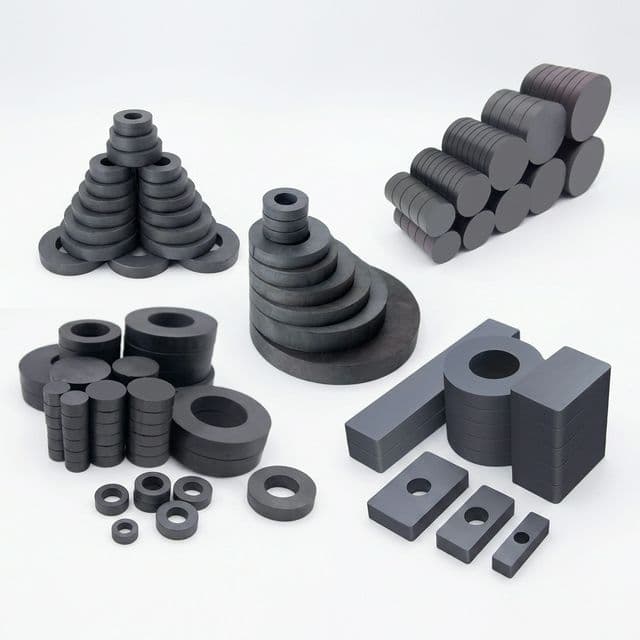
2023 Ceramic Ring Magnets Manufacturer: screen first, then validate with evidence and risks
This is a single integrated manufacturer-decision page: the first screen gives usable outputs, while the middle and lower sections add shortlist method, evidence, boundaries, and risk controls.
Published: April 21, 2026 · Last reviewed: April 23, 2026
Gap audit and fix log for this round
Audit before enhancement: this table lists high-impact gaps in the existing page, potential decision bias, and the concrete fixes implemented in this round (checked April 23, 2026).
| Gap type | Observed issue | Decision impact | Stage1b fix action |
|---|---|---|---|
| Evidence boundary gap | Boundary between strontium signals and magnet pricing was not explicit enough. | May overstate direct price inference from upstream material signals. | Added USGS end-use split and import-source mix to make proxy usage explicit. |
| Comparison-depth gap | Trade section lacked 2023/2024 comparison and implied unit-value movement. | Hard to spot counterexamples such as volume drop with value-mix uplift. | Added annual baseline plus unit-value swing, with explicit HS aggregation limits. |
| Fallback-risk gap | NdFeB fallback emphasized price but not policy and concentration risks. | Could underestimate execution risk when switching material paths. | Added USGS rare-earth source split and 2025 export-control timeline. |
| Concept-boundary gap | FOB/CIF/DDP scope was not clearly separated from full contract terms. | May misread Incoterms as covering payment/title/dispute terms. | Added ITA Incoterms scope plus explicit non-covered items. |
| Data-availability gap | Only U.S. 2025 pending state was shown; China-side status was missing. | Could lead to one-sided interpretation of full-year 2025 trend. | Added China 2025 same-code pending marker and kept conclusions non-assertive. |
Core conclusions and key numbers
Decision statements first, evidence second. Every conclusion is tied to a source-backed number or explicit uncertainty marker.
When lead target is <=6 weeks with <=+/-0.08 mm tolerance, suppliers lacking process evidence amplify rework risk.
The same part can move materially across FOB/CIF/DDP and supplier-capability tiers, so use range plus confidence.
Encode rolling forecast, dual-source, and switch triggers into manufacturer governance checkpoints.
When outside boundaries, the tool should return a minimal executable fallback and route to manual review.
| Result type | Observed share | User intent signal | How this page responds |
|---|---|---|---|
| Supplier/catalog pages | High | Find available manufacturers first, then decide RFQ readiness | First screen provides tool output + risk level + explicit next-step CTA |
| Specification pages | Med-high | Need quick alignment on OD/ID/thickness/grade/magnetization | Tool layer accepts exactly these inputs and returns explainable ranges |
| RFQ/quote entry pages | Medium | Want fast escalation to human quotation, not long concept-only reading | Every status includes a next action, including boundary-state fallback path |
| Manufacturer tier | Evidence completeness | Delivery signal | Best fit |
|---|---|---|---|
| Tier A: primary candidate | High (8/10+) | Can provide PPAP/FAI package, process capability, and lot traceability | Mass production or critical specs requiring stable delivery |
| Tier B: backup candidate | Medium (6-8/10) | Competitive quote but partial documentation/process evidence | Use as transitional or regional backup, not sole source |
| Tier C: watchlist | Low (<6/10) | Catalog visible but missing critical process and quality evidence | Pilot-only validation before entering critical programs |
Method: quote envelope plus manufacturer-screening basis
The method layer exposes formulas, coefficients, and screening logic so you can judge transferability to your own program and supply chain reality.
volume_cm3 = PI * ((OD/2)^2 - (ID/2)^2) * T / 1000 mass_g = volume_cm3 * 4.8 unit_cost = (material + process) * volume_factor * incoterm_factor lead_window = base_lead + tolerance_penalty + qa_penalty +/- risk_buffer supplier_fit_score = 0.35*process_docs + 0.25*delivery_history + 0.25*quality_response + 0.15*cost_stability
Note: 4.8 g/cm3 is an engineering default. IEC 60404-8-1 indicates class-specific values should be used where available; material/process rates remain model coefficients, not contractual unit prices. Per U.S. ITA, Incoterms define logistics responsibilities only and do not cover title transfer, payment terms, or dispute resolution.
| Parameter | Default / range | Role in output | Boundary note |
|---|---|---|---|
| Density | 4.8 g/cm3 | Sets part mass and material baseline | Replace with measured density for special recipes |
| Tolerance range | +/-0.03 to +/-0.50 mm | Drives grinding complexity and scrap risk | Outside range triggers boundary state |
| Target lead time | 3-20 weeks | Interacts with process load for risk grading | Compressed targets trigger expedited recommendation |
| Incoterm | FOB / CIF / DDP | Impacts logistics cost and transparency | DDP is convenient but least transparent in cost components |
| Manufacturer evidence score | 0-10 scale | Controls speed of moving a supplier into Tier A/B/C | Scores below 6 should stay at watchlist or pilot-only stage |
Evidence sources and boundary notes
The table below specifies source, date, data lens, and usage. Items without strong public evidence are marked as N/A with reason.
| Metric | Value | Source | Date marker | Use / boundary |
|---|---|---|---|---|
| U.S. strontium apparent consumption (total) | 5,330 t (2023) -> 3,650 t (2024) -> 12,000 t (2025 estimate) | USGS Mineral Commodity Summaries 2026 Data Release (Commodities CSV) | Published February 6, 2026 | Proxy signal for ferrite precursor exposure, not a direct ring-magnet quote. |
| U.S. celestite import unit value (dollars per ton) | 82 (2023) -> 807 (2024) -> 160 (2025 estimate) | USGS Mineral Commodity Summaries 2026 Data Release (Commodities CSV) | Published February 6, 2026 | Used as volatility indicator for upstream feedstock timing risk. |
| U.S. net import reliance (strontium) | 100% (2023-2025 estimate) | USGS Mineral Commodity Summaries 2026 Data Release (Commodities CSV) | Published February 6, 2026 | Supply chain shock buffer must be planned in lead-time strategy. |
| U.S. net import reliance (rare-earth compounds/metals) | >90 (2023) -> 53 (2024) -> 67 (2025 estimate) | USGS Mineral Commodity Summaries 2026 Data Release (Commodities CSV) | Published February 6, 2026 | Critical when benchmarking ferrite against NdFeB fallback paths. |
| NdPr oxide average price | $75/kg (2023) -> $55/kg (2024) -> $69/kg (2025 estimate) | USGS Mineral Commodity Summaries 2026 Data Release (Commodities CSV) | Last checked April 21, 2026 | Counterexample anchor: NdFeB economics can shift as NdPr prices rebound. |
| Permanent magnet test-method boundary | IEC 60404-5: methods for B, J, H measurements and demagnetization/recoil curves | IEC 60404-5:2015 product scope | Last checked April 21, 2026 | Defines what constitutes comparable magnetic-property measurement conditions. |
| Permanent magnet specification boundary | IEC 60404-8-1: minimum magnetic-property values and dimensional tolerances by material class | IEC 60404-8-1:2023 product scope | Last checked April 21, 2026 | Supports the page boundary: grade-specific values must come from class-specific specs. |
| EU RoHS restricted-substance thresholds | 0.1% for Pb/Hg/Cr6+/PBB/PBDE/DEHP/BBP/DBP/DIBP; 0.01% for Cd | Directive 2011/65/EU (consolidated), Annex II | Consolidated text checked April 21, 2026 | Applies to homogeneous materials in EEE and affects export compliance documentation. |
| REACH Article 33 communication trigger | SVHC above 0.1% w/w requires communication; consumer requests answered within 45 days | Regulation (EC) No 1907/2006 (REACH), Article 33 | Consolidated text checked April 21, 2026 | Directly impacts RFQ package completeness for EU-bound shipments. |
| China exports, HS 850511 (permanent magnets, 2024) | World total 3,236,652.39; U.S. destination 395,313.45 (thousand USD, 12.2% share) | WITS / UN Comtrade country-year-product view | Last checked April 21, 2026 | Trade table context for supplier concentration and negotiation leverage. |
| U.S. imports, HS 850511 (2024) | World total 478,125.34; China 359,791.11 (thousand USD, 75.3% share) | WITS / UN Comtrade country-year-product view | Last checked April 21, 2026 | Supports risk section on origin concentration and dual-sourcing. |
| U.S. imports, HS 850511 (2025 annual snapshot) | N/A for annual total on WITS page as of check date ("did not imports ... in 2025") | WITS / UN Comtrade country-year-product view | Last checked April 21, 2026 | Treat as pending confirmation; do not force 2025 annual conclusions from this page. |
| U.S. strontium end-use distribution (2025 estimate) | Drilling fluids 65%; ceramic ferrite magnets 14%; pyrotechnics/signals 14%; other 7% | USGS MCS 2026 Strontium chapter (PDF) | Published February 2026, checked April 23, 2026 | Confirms strontium is only a proxy signal; ferrite magnets are one subset of total demand. |
| U.S. strontium import source split (2021-2024) | Celestite: Mexico >99%; compounds: Germany 51%, Mexico 41%, China 3%, other 5% | USGS MCS 2026 Strontium chapter (PDF) | Published February 2026, checked April 23, 2026 | Useful for upstream source-diversification planning before RFQ lock-in. |
| U.S. rare-earth import source split (2021-2024) | China 71%; Malaysia 13%; Japan 5%; Estonia 5%; other 6% | USGS MCS 2026 Rare Earths chapter (PDF) | Published February 2026, checked April 23, 2026 | Counterexample context: rare-earth fallback path still has concentrated exposure. |
| China rare-earth export control events (2025) | Controls tightened in April 2025; expanded in October; October controls suspended for one year in November | USGS MCS 2026 Rare Earths chapter (PDF) | Published February 2026, checked April 23, 2026 | Shows that NdFeB fallback should include policy-timing risk, not just material price. |
| Incoterms boundary for quotation interpretation | Incoterms 2020 has 11 rules (7 any mode, 4 sea/inland), but does not define title transfer, payment terms, or dispute resolution | U.S. International Trade Administration: Know Your Incoterms | Checked April 23, 2026 | Supports tool boundary: FOB/CIF/DDP affects logistics scope but not the full commercial contract. |
| U.S. imports, HS 850511 (2023 baseline) | World total 558,207.88; China 445,485.22 (thousand USD, 79.8% share) | WITS / UN Comtrade country-year-product view | Checked April 23, 2026 | Provides baseline to compare 2024 concentration and trend direction. |
| U.S. HS 850511 implied unit-value shift (2023 -> 2024) | $18.58/kg (2023) -> $50.83/kg (2024), +173.5%; value -14.35% while quantity dropped from 30,040,900 to 9,407,080 kg | Calculated from WITS / UN Comtrade USA 2023 and 2024 pages | Calculated April 23, 2026 | Boundary reminder: HS aggregate movement may reflect mix/reporting shifts, not pure ferrite-ring demand. |
| China exports, HS 850511 (U.S. share shift) | U.S. destination share 13.78% (2023) -> 12.21% (2024); export value to U.S. -22.26% YoY | WITS / UN Comtrade country-year-product view | Checked April 23, 2026 | Adds negotiation context: U.S. remains material but is a decreasing share of China’s same-code exports. |
| China exports, HS 850511 (2025 annual snapshot) | N/A for annual total on WITS page as of check date ("did not exports ... in 2025") | WITS / UN Comtrade country-year-product view | Checked April 23, 2026 | Marked pending confirmation; avoid forcing 2025 full-year export conclusions. |
| Dimension | 2023 | 2024 | Decision implication |
|---|---|---|---|
| U.S. HS 850511 import value (thousand USD) | 558,207.88 | 478,125.34 | -14.35% YoY; interpret together with quantity and mix signals. |
| U.S. HS 850511 import quantity (kg) | 30,040,900 | 9,407,080 | About -68.69% YoY; should not be directly treated as ferrite-ring demand collapse. |
| Implied unit value (USD/kg) | 18.58 | 50.83 | +173.5% YoY, indicating product-mix/reporting-effect risk. |
| China share in U.S. imports | 79.81% | 75.25% | Still high in absolute terms; dual-source planning remains a high-priority control. |
| U.S. share in China exports (same code) | 13.78% | 12.21% | U.S. remains material, but its share in China export mix declined. |
| Dimension | Status | Explanation |
|---|---|---|
| Material-side volatility signal | Known | Supported by annual USGS datasets. |
| Global trade concentration | Known | Supported by WITS/Comtrade 2024 pages, with 2025 annual pages marked pending; HS 850511 is not ferrite-ring-only. |
| Grade-level density and magnetic-property details | Partially known | IEC 60404-8-1 confirms class-specific minimums and tolerances, but full tabular values are not open on the product page. |
| Real-time single-manufacturer loading | N/A | Not publicly available; requires supplier-level NDA data. |
| Drawing-specific scrap rate | N/A | Needs first-run and pilot SPC data. |
| Incoterms vs contract-term completeness | Known | ITA states Incoterms do not define payment, title transfer, or dispute clauses; contract terms are still required. |
Concept boundaries and applicability conditions
Use this table to avoid over-interpretation: what can drive decisions directly, what is only a proxy signal, and what must be validated during RFQ.
| Signal / source | Use directly for | Not valid alone for | Minimum executable action |
|---|---|---|---|
| USGS strontium series | Detect feedstock volatility windows | Derive binding per-piece contract price | Use it as risk coefficient, not as quote base value |
| WITS HS 850511 trade data | Judge source concentration and backup urgency | Treat as ferrite-ring-only market view | Split by drawing/application before final sourcing decisions |
| IEC 60404-5 / 60404-8-1 | Align measurement and specification basis | Replace grade-specific measured reports | Require grade-specific test reports during RFQ |
| RoHS / REACH legal thresholds | Determine whether compliance actions are triggered | Replace third-party lab verification | Write thresholds into incoming-spec and document checklist |
| U.S. ITA Incoterms guidance | Allocate logistics, insurance, and customs responsibilities | Replace payment, title, or dispute clauses | Submit Incoterm choice together with a commercial-terms sheet in RFQ package |
| Counterexample scenario | Why this page is limited | Practical fallback path |
|---|---|---|
| High energy-product requirement with strict volume limits | Ferrite route may fail required flux-density targets | Run NdFeB fallback in parallel and re-check against NdPr sensitivity |
| Radial magnetization + tight tolerance (<=+/-0.08 mm) + under 6 weeks | Stacked process complexity and scrap risk widen output uncertainty | Run pilot lot with PPAP/FAI gate before locking production schedule |
| Decisions requiring full-year 2025 trade totals | WITS 2025 page currently shows “did not imports/exports”; annual totals remain unconfirmed | Base decisions on confirmed 2024 totals, then schedule quarterly revalidation for 2025 |
| Treating single-year HS 850511 quantity change as ferrite-ring demand change | The code aggregates multiple permanent-magnet classes, while implied unit value jumped 173.5% from 2023 to 2024, indicating mix/reporting noise | Use part-level RFQ volumes, pilot-to-mass ramp timing, and supplier shipment logs for second-pass validation |
Manufacturer engagement path comparison
This compares collaboration routes rather than magnetic material superiority, helping reduce supply disruption and execution drift.
| Path | Cost predictability | Evidence transparency | Supply-risk exposure | Best-fit scenario |
|---|---|---|---|---|
| Direct manufacturer | Med-high (when specs are clear) | High (direct access to process and quality evidence) | Medium (dual-source governance remains your responsibility) | Medium-high volume programs with complex specs |
| Trading-company route | Medium (operationally convenient) | Med-low (secondary source visibility required) | Med-high (upstream switch risk can be opaque) | Multi-category, lower-volume, bundled procurement |
| Local stocking distributor | High (short-term) / low (long-term) | High (fixed specs and fast order response) | Medium (stock-out and substitute-part risk) | Prototype, after-sales, short-lead replenishment |
Risk matrix and mitigation actions
| Risk type | Trigger | Mitigation |
|---|---|---|
| Misuse risk | Estimator output treated as contract quote without RoHS/REACH trigger checks | Enforce RFQ gate: drawing + quality package + 0.1%/0.01% limit declaration + Article 33 response flow |
| Contract-boundary risk | FOB/CIF/DDP is selected without explicit payment milestones, title transfer, and dispute clauses | Require a commercial-terms sheet at RFQ stage with joint legal-procurement review |
| Cost risk | Lead target <=6 weeks with tolerance <=+/-0.08 mm (especially radial magnetization) | Use expedited lane with weekly forecast lock and run pilot validation before scale-up |
| Scenario mismatch risk | High energy-density requirement but ferrite selected | Run NdFeB fallback and include sensitivity to NdPr rebound from 2024 to 2025 estimate |
| Supply concentration risk | Same-code import concentration >=70% from one origin while still single-sourced | Dual-source minimum plus safety-stock trigger with emergency switch-lot plan |
| Data availability risk | Decision requires full-year 2025 trade totals but public page is still unconfirmed | Execute on confirmed 2024 data first and set quarterly revalidation gate |
Scenario A: standard tolerance scale
Assumption: 800k pcs annual demand, +/-0.12mm tolerance, axial magnetization.
Process: Use baseline lead lane with quarterly rolling forecast lock.
Outcome: Cost volatility remains controllable; recommended default sourcing path.
Scenario B: compressed launch schedule
Assumption: Lead target below 6 weeks with PPAP package required.
Process: Switch to expedited lane, increase scrap buffer, and split shipments.
Outcome: Schedule can be met but unit-cost envelope widens materially.
Scenario C: low-volatility first
Assumption: Program allows +1 to +2 weeks in exchange for lower volatility.
Process: Use buffered lane with explicit safety-stock triggers.
Outcome: More stable total landed cost; suitable for long-life products.
FAQ
FAQs are grouped for decision intent: scope validation, risk judgment, and execution next steps.
Disclaimer: this page supports pre-contract sourcing decisions and does not constitute legal, compliance, or binding commercial terms.