
Anisotropic Ferrite Magnet Suppliers: Run the Checker, Then Validate the Evidence
Screen anisotropic ferrite magnet suppliers with a shortlist checker, then validate capability, risk, and sourcing evidence before RFQ award. Contact sales.
By FerriteCustom Editorial Team | Reviewed by FerriteCustom Sales Engineering (Q2 2026).
Evidence cadence: quarterly review. Latest source refresh completed April 26, 2026. Next scheduled refresh: July 2026 (aligned with ECHA Candidate List data-location transition window).
Tool-first screening model for buyer-side supplier shortlisting. Use this for triage, then move to evidence-backed RFQ validation.
Boundary model: 5-6000k pieces/year.
Smaller tolerance values require stronger process capability.
Boundary model: 2-20 weeks.
| Model item | Implementation detail | Why it matters |
|---|---|---|
| Input guardrails | Volume (5-6000k), tolerance (0.03-1.2 mm), lead time (2-20 weeks) boundaries are validated before scoring. | Prevents overconfident outputs from unrealistic planning inputs. |
| Capability weighting | Process ownership and evidence depth carry the highest weight in score contribution. | Supplier execution quality matters more than brochure-level product claims. |
| Boundary fallback | Out-of-range inputs return a boundary state with an explicit manual-audit path. | Keeps the tool actionable when a numeric score would be misleading. |
| Deterministic output | Same inputs produce the same result; loading state locks inputs to avoid race conditions. | Improves reproducibility for cross-functional buyer-engineer review. |
Core conclusions for supplier decision
Each conclusion includes metric signal, use boundary, and source anchor so buyers can act without losing audit traceability.
Teams should prioritize suppliers with traceable in-house process control when sourcing anisotropic ferrite magnets.
Suitable for
Programs with repeat lots, dimensional consistency targets, and PPAP-style validation gates.
Not suitable for
Projects selecting suppliers from unit-price comparison only.
Source: Tool transparency model + MMPA acceptance guidance (section 9.1).
If two suppliers use different measurement assumptions, datasheet values can look similar but still be non-comparable in your circuit.
Suitable for
Teams requiring cross-supplier technical comparability before RFQ award.
Not suitable for
Programs accepting catalog property tables without method declaration.
Source: MMPA 0100-00 + IEC 60404-5:2015 + IEC 60404-18:2025.
Tight tolerance quotes need matching grinding and magnetization capability evidence, not only grade labels.
Suitable for
Programs with strict dimensional and magnetic consistency criteria.
Not suitable for
Programs treating ferrite parts as generic high-ductility structural components.
Source: MMPA 0100-00 section I + section III table notes.
Schedule commitments are credible only when supplier buffering and substitution plans are visible in RFQ.
Suitable for
Teams balancing launch speed with material continuity risk.
Not suitable for
Programs accepting rush commitments without upstream risk evidence.
Source: USGS Mineral Commodity Summaries 2026 - Strontium.
Supplier shortlists for EU-bound products should include declaration format, threshold logic, and update cadence checks.
Suitable for
Programs shipping EEE or article-containing assemblies into EU-regulated supply chains.
Not suitable for
Award decisions that rely on generic “compliant” statements without threshold evidence.
Source: Directive 2011/65/EU + Delegated Directive (EU) 2015/863 + ECHA Candidate List table.
Dual-source only works when both routes pass identical evidence gates and substitution triggers include explicit fallback-cost assumptions (IEA cites about USD 200 million for a one-year strategic stockpile outside China).
Suitable for
Teams designing continuity plans across ferrite base case and rare-earth fallback scenarios.
Not suitable for
Programs that add supplier count without harmonized qualification and substitution criteria.
Source: USGS MCS 2026 (Strontium + Rare Earths) + IEA 2026.
Content gap audit and closure log
| Audited gap | Decision risk if unchanged | Stage1b closure applied |
|---|---|---|
| SERP intent was ambiguous between catalog pages and sourcing-evaluation guides | Publishing a pure content page could miss immediate do-intent and lose conversion on first screen. | Built a single-URL hybrid page: first-screen supplier checker + immediate result CTA, then report sections for evidence and risk. |
| Keyword angle risked duplication with existing manufacturer page | Two near-identical pages could cannibalize each other and reduce decision clarity. | Shifted this page to supplier-channel decisions: route model, quote normalization, and Incoterm-aware planning that are not central in the manufacturer page. |
| Public sourcing pages often lacked test-method comparability boundaries | Buyers could compare Br/Hc numbers from mismatched methods and lock a weak shortlist. | Added IEC 60404-5 / 60404-8-1 / 60404-18 standard gates and explicit method declaration requirements. |
| Compliance language in supplier pages is often narrative-only | RoHS/REACH screening could pass pre-sales but fail customer audit at release stage. | Added numeric RoHS thresholds, REACH Article references, Candidate List count, and SCIP trigger context into RFQ gating. |
| RoHS summary risked under-scoping Annex II substance coverage | Missing DEHP/BBP/DBP/DIBP checks can produce false “compliant” conclusions for EU EEE projects. | Expanded compliance gates to full 10-substance Annex II scope and added date boundary from Delegated Directive (EU) 2015/863. |
| Supply-volatility section lacked landed-cost normalization detail | Supplier ranking could ignore import-source concentration and tariff assumptions that shift total cost. | Added USGS import-source shares and U.S. tariff baseline to quote-normalization and key-fact sections. |
| Automotive scenario lacked explicit supplier-QMS progression boundary | Teams may over-accept ISO 9001 narrative claims where customer programs require IATF progression evidence. | Added IATF 16949 clause 8.4.2.3 gate and scenario-level execution note for automotive sourcing. |
| Compliance-monitoring continuity across 2026 dataset transition was implicit | Automated SVHC watch pipelines may silently stale during ECHA Candidate List data-location migration. | Added July 2026 ECHA transition boundary and explicit migration action in standards and uncertainty sections. |
Search-intent signals and page response
| Observed SERP pattern | Decision implication | Page response on this URL |
|---|---|---|
| Top results are mostly product listings or manufacturer profile pages | Searchers likely want an immediate shortlist action, not theory first. | Tool block is placed above the fold with deterministic result feedback and next-step CTA. |
| Directory/list pages provide supplier names but weak comparability logic | Users still need a decision frame for ranking suppliers consistently. | Comparison and route tables normalize process ownership, evidence depth, and lead-time assumptions. |
| Few pages disclose compliance and method boundaries in one place | Teams face late-stage quality/compliance surprises despite early quote progress. | RFQ checklist combines magnetic-test method gates with RoHS/REACH/SCIP evidence expectations. |
| Most pages understate uncertainty and data gaps | Buyers can over-trust narrative claims without clear fallback paths. | Known-unknown table and boundary-state behavior keep uncertain areas explicit and actionable. |
Supplier route matrix (distinct from manufacturer-only page)
| Supplier route | Best fit | Main risk | Minimum gate |
|---|---|---|---|
| Direct integrated manufacturer | Stable annual volume, strict tolerance, recurring SKUs | Over-reliance on one plant if dual-source is not designed early | Lot Cpk + magnetic method declaration + continuity disclosure before final award |
| Manufacturer + qualified regional distributor | Shorter local replenishment windows and mixed order sizes | Evidence dilution between factory data and distributor claims | Traceability chain from shipment lot back to factory test report |
| Sourcing office / procurement partner | Teams without local audit bandwidth | Capability visibility may be abstracted by intermediary scoring | Named factory list, audit artifacts, and escalation SLA in contract annex |
| Trading-only channel | Low-criticality spot buys | Weak repeatability and uncertain process ownership | Use only for non-critical demand; keep an integrated route in parallel |
| Dual route (integrated + fallback channel) | Launch programs needing continuity under volatility | False resilience if both routes share same upstream bottleneck | Independent upstream disclosure and identical acceptance criteria across both routes |
Quote normalization table before supplier ranking
| Normalization field | Why it matters | Required at RFQ |
|---|---|---|
| Grade baseline mapping (IEC/MMPA) | Avoids false equivalence from internal grade naming | Supplier mapping table with reference standard and test route |
| Magnetic acceptance method | Br/Hc values are not comparable without method context | IEC 60404-5 or 60404-18 declaration plus load-line acceptance definition |
| Tolerance and metrology setup | Quoted tolerance is meaningless without measurement discipline | Gauge method, sampling plan, and historical lot capability evidence |
| Incoterm + logistics scope | Unit-price ranking can invert after freight and handling assumptions | Same Incoterm, packaging standard, and destination assumptions across suppliers |
| Tariff and customs baseline (U.S.-bound programs) | Landed-cost comparison can be distorted if duty assumptions are not normalized. | Declare HTS mapping and duty assumptions (USGS 2026: celestite free, strontium metal 3.7%, key compounds 4.2% NTR at 2025-12-31 baseline). |
| Compliance thresholds (RoHS/REACH/SCIP) | Narrative-only claims can fail customer compliance review | Threshold-level evidence and Article 33 communication readiness |
| Continuity and disruption response | Lead-time promises are fragile under upstream shocks | Buffer policy, upstream route note, and disruption escalation process |
Key numbers and date context
| Fact | Value | Date context | Decision implication | Source |
|---|---|---|---|---|
| Anisotropic vs isotropic ferrite baseline | MMPA C1 BHmax 1.0 MGOe vs C5/C8 BHmax 3.5-3.7 MGOe | MMPA 0100-00 (accessed April 24, 2026) | Supplier screening should focus on anisotropic process capability, not isotropic assumptions. | MMPA Standard 0100-00 |
| Acceptance-method warning | MMPA section 9.1 recommends minimum flux/load-line acceptance, not Br/Hc table values alone | MMPA 0100-00 section 9.1 | RFQ should include agreed test method and reference sample for award decisions. | MMPA Standard 0100-00 |
| Magnetization saturation requirement | MMPA note: achieving table properties typically needs 10,000-15,000 Oe saturation magnetization field (grade-dependent). | MMPA 0100-00 table note (accessed April 24, 2026) | RFQ should request magnetization fixture capability and saturation evidence for the target grade. | MMPA Standard 0100-00 |
| Closed-circuit vs open-circuit method boundary | IEC 60404-5 (2015) defines closed-circuit measurements; IEC 60404-18 (2025) defines SCM open-circuit method with self-demag correction. | IEC publications dated 2015-04-16 and 2025-02-20 | Supplier data should declare method family before cross-vendor comparison. | IEC 60404-5 + IEC 60404-18 |
| RoHS Annex II thresholds | Cd 0.01%; Pb/Hg/Cr(VI)/PBB/PBDE/DEHP/BBP/DBP/DIBP 0.1% by weight in homogeneous material. | Directive 2011/65/EU Annex II + Delegated Directive (EU) 2015/863 (published 2015-06-04) | Compliance declaration must include material-level threshold mapping, not generic pass/fail wording. | EUR-Lex (Directive 2011/65/EU + Delegated Directive 2015/863) |
| REACH Candidate List scale and legal trigger | ECHA Candidate List table shows 253 entries, latest inclusion date 04-Feb-2026, and immediate legal obligations under REACH Articles 7, 31, and 33. | ECHA Candidate List table (accessed April 26, 2026) | Supplier change-management cadence should track list updates and downstream communication duty. | ECHA Candidate List table |
| ECHA data-location transition boundary | Candidate List page notes dataset continuity at current location only until July 2026 as ECHA CHEM transition progresses. | ECHA Candidate List page notice (accessed April 26, 2026) | Compliance watch workflows should migrate data source endpoints before July 2026 to avoid stale SVHC alerts. | ECHA Candidate List table notice |
| SCIP concentration threshold | SCIP support states notifications concern articles containing Candidate List substances above 0.1% w/w. | ECHA SCIP support page (accessed April 26, 2026) | EU article suppliers (and their upstream partners) need data structures that can support SCIP dossier preparation when threshold is exceeded. | ECHA SCIP support |
| Strontium end-use relevance | USGS 2026 U.S. estimate: ceramic ferrite magnets account for about 14% of strontium end use | USGS Strontium chapter 2026 | Ferrite supply monitoring should include strontium-chain visibility. | USGS MCS 2026 - Strontium |
| U.S. strontium dependency | USGS 2026 reports 100% U.S. net import reliance for strontium in 2025. | USGS Strontium chapter 2026 | Continuity planning should include import-route and buffer-stock assumptions. | USGS MCS 2026 - Strontium |
| U.S. strontium import-source concentration | USGS 2026 import source mix (2021-24): total imports Mexico 64%, Germany 31%, other 5%; strontium compounds Germany 51%, Mexico 41%, China 3%. | USGS Strontium chapter 2026 (import sources 2021-24) | Supplier continuity plans should disclose upstream route dependence and non-overlapping backup paths. | USGS MCS 2026 - Strontium |
| U.S. tariff baseline for strontium-linked inputs | USGS tariff table (NTR as of 2025-12-31): celestite free, strontium metal 3.7%, and key compounds (oxide/hydroxide/peroxide/nitrate/carbonate) 4.2% ad valorem. | USGS Strontium tariff table 2026 | Landed-cost comparisons should normalize duty assumptions before ranking supplier quotes. | USGS MCS 2026 - Strontium |
| Global strontium-chain volatility signal | USGS: world celestite output 400,000 tons (2024) to 450,000 tons (2025), while 2025 strontium carbonate supply was disrupted by multiple events. | USGS Strontium chapter 2026 | Lead-time promises should be checked against upstream disruption-response plans. | USGS MCS 2026 - Strontium |
| Rare-earth fallback concentration (boundary context) | USGS 2026: U.S. rare-earth compounds/metals imports were 71% from China (2021-2024); IEA 2026: China shares were 60% mining, 91% refining, and 94% sintered magnets in 2024. | USGS Rare Earths 2026 + IEA Rare Earth Elements 2026 | If ferrite programs define NdFeB fallback routes, concentration exposure should be disclosed across mining/refining/magnet stages. | USGS MCS 2026 - Rare Earths + IEA 2026 |
| Fallback stockpile cost boundary (outside China) | IEA 2026 estimates about USD 200 million to cover one year of exposed magnet rare-earth imports via strategic stockpile. | IEA Rare Earth Elements 2026 executive summary | Fallback strategy should include explicit cash-flow and timing assumptions, not only technical feasibility. | IEA Rare Earth Elements 2026 |
| Ferrite thermal behavior boundary | MMPA ceramic typicals: Curie ~460°C, max service ~250°C, Br coefficient around -0.20%/°C | MMPA 0100-00 Table III-5 | Suppliers should be evaluated on thermal-derating and demag validation ability. | MMPA Standard 0100-00 |
| Automotive supplier-QMS progression boundary | IATF 16949 sanctioned interpretation for clause 8.4.2.3 sets minimum acceptable supplier-QMS level at ISO 9001 (customer-authorized exceptions possible) and progression toward IATF 16949. | IATF sanctioned interpretations PDF (accessed April 26, 2026), clause 8.4.2.3 | Automotive ferrite sourcing should not stop at generic ISO 9001 claims when customer flow-down requires progression evidence. | IATF 16949 sanctioned interpretations |
Standards and compliance gates
| Gate | Minimum requirement | Applicable condition | If missing | Source |
|---|---|---|---|---|
| Magnetic measurement route declaration | Supplier data package should declare whether results follow IEC 60404-5 closed-circuit method or IEC 60404-18 open-circuit SCM method (with correction approach). | Any cross-supplier magnetic curve comparison or final technical ranking. | Curves may be compared as if equivalent while measurement assumptions differ. | IEC 60404-5:2015 + IEC 60404-18:2025 |
| Material-grade baseline mapping | RFQ should map supplier grade naming to recognized baseline specification (IEC 60404-8-1 and/or MMPA tables) before comparing BHmax/Br claims. | Multi-vendor grade comparison or substitution decisions. | “Same grade” language can hide non-equivalent material baselines. | IEC 60404-8-1:2023 + MMPA 0100-00 |
| RoHS homogeneous-material threshold file | Declaration should provide substance-level evidence for all Annex II thresholds: Cd 0.01% plus Pb/Hg/Cr(VI)/PBB/PBDE/DEHP/BBP/DBP/DIBP at 0.1%. | EU EEE shipment or downstream compliance review. | Supplier can pass narrative compliance check but fail customer audit evidence review. | Directive 2011/65/EU Annex II + Delegated Directive (EU) 2015/863 |
| REACH / SCIP article disclosure readiness | For EU article supply, require Candidate List review cadence, REACH Article 33 communication path, and SCIP dossier readiness when >0.1% w/w threshold is exceeded. | EU article-containing assemblies in scope of REACH/WFD workflows, including supplier data handoff to the EU notifier. | Late-stage legal communication gaps can delay customer approval and shipment. | ECHA Candidate List table + ECHA SCIP support |
| Automotive supplier-QMS progression evidence | When automotive customer flow-down applies, require clause 8.4.2.3-aligned supplier-QMS progression evidence beyond generic certificate statements. | Automotive programs, PPAP-driven projects, or customer contracts referencing IATF 16949 supplier development. | Supplier can appear qualified at quote stage but fail customer-specific quality-system gate before SOP. | IATF 16949 sanctioned interpretations, clause 8.4.2.3 |
| Strontium-chain continuity evidence | Supplier should disclose strontium feedstock route, buffer strategy, and disruption-response plan. | Programs with strict launch windows or low interruption tolerance. | Lead-time commitment is weak against upstream disruption shocks. | USGS MCS 2026 - Strontium |
| SVHC watch pipeline migration check | Compliance workflows should verify Candidate List data-source migration to ECHA CHEM before July 2026. | Any automated or semi-automated SVHC monitoring process used for supplier qualification. | Regulatory alerts can silently stale during endpoint transition and miss newly listed substances. | ECHA Candidate List table notice (transition to ECHA CHEM) |
Applicable and non-applicable audience boundaries
| Audience profile | Fit level | Why this page helps | Where this page is not enough |
|---|---|---|---|
| OEM buyer with volume >100k and formal quality gate | Strong fit | Tool supports rapid shortlist plus evidence-based RFQ handoff for anisotropic ferrite sourcing. | Not for final supplier award without sample-lot verification and acceptance tests. |
| Engineering manager comparing process-capable suppliers | Strong fit | Combines tolerance, lead-time, and evidence-depth logic with explicit boundary disclosures. | Not sufficient for geometry-specific magnetic-circuit sign-off. |
| Price-only sourcing flow under rush schedule | Conditional to low fit | Page highlights why quote speed alone can hide capability and quality-system risk. | Not suitable if the team refuses to collect lot evidence before award. |
| Prototype team with no audit bandwidth | Conditional | Can still use the boundary and fallback guidance to avoid high-risk supplier lock-in. | Not a replacement for minimum supplier due diligence in production programs. |
Supplier class comparison for anisotropic ferrite programs
| Dimension | Integrated manufacturer | Hybrid subcontract model | Trading profile | Decision implication |
|---|---|---|---|---|
| Process ownership | Pressing + sintering + grinding + magnetization in one system | Core process in-house, critical steps subcontracted | Mostly outsourced manufacturing and QC | Integrated ownership usually supports stronger repeatability and faster root-cause response. |
| Evidence depth at RFQ stage | Lot reports, Cpk trend, acceptance method alignment | Partial reports, sample-level evidence | Catalog data with limited lot traceability | Evidence depth should determine shortlist rank before quote comparison. |
| Tolerance capability confidence | Higher confidence for tight tolerance programs | Depends on subcontract grinding control | Often uncertain until pilot failure appears | Tolerance risk should be priced into supplier ranking, not deferred. |
| Schedule resilience | Better control when plan changes or defect correction is needed | Moderate resilience with coordination overhead | High delay risk when upstream changes occur | Lead-time promises are only credible with process control evidence. |
| Best-fit procurement objective | Long program stability and quality consistency | Balanced cost with moderate technical risk | Low-complexity, non-critical orders only | Supplier class should match risk tolerance and quality criticality. |
Methodology and scoring evidence chain
This page keeps one URL so do-intent and know-intent do not compete. The tool gives immediate direction; the report section validates whether the direction is defensible.
| Method step | Implementation action | Output |
|---|---|---|
| Step 1: Capture constraints | Collect annual demand, tolerance target, lead-time window, compliance class, and sourcing strategy. | Normalized screening input snapshot. |
| Step 2: Run deterministic score | Apply weighted capability model with boundary checks and controlled loading state. | Strong / conditional / low / boundary result with score. |
| Step 3: Map result to evidence gates | Connect score to minimum RFQ evidence: load-line acceptance method, lot reports, and audit visibility. | Executable next-step action for buyer and engineering teams. |
| Step 4: Build fallback path | If confidence is low or boundary-triggered, enforce side-by-side supplier comparison and pilot validation. | Minimal safe continuation path without blocking the project. |
RFQ and validation checklist
| Checklist item | Minimum requirement | Why this matters | Source anchor |
|---|---|---|---|
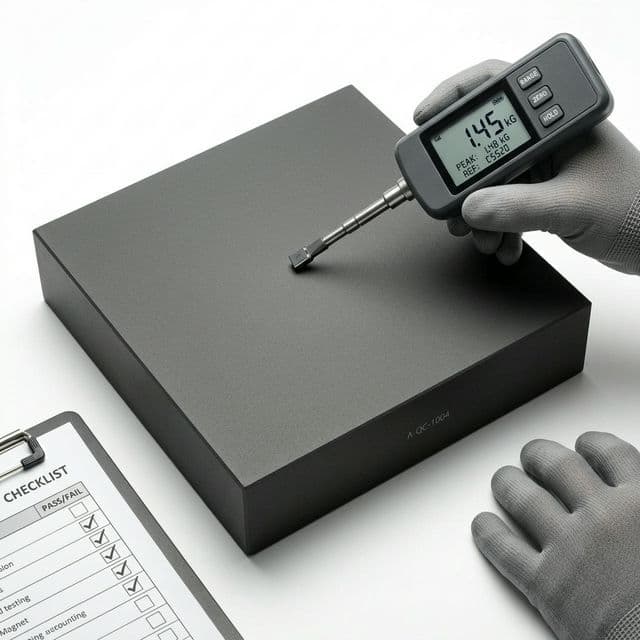
| Acceptance method alignment | Define load-line or minimum flux acceptance criteria, not Br/Hc table values only. | Prevents acceptance disputes between buyer and supplier test setups. | MMPA 0100-00 section 9.1 |
| Magnetic test-method declaration | Require each supplier to declare whether data follows IEC 60404-5 (closed circuit) or IEC 60404-18 (open circuit SCM) measurement routes. | Prevents false equivalence when comparing magnetic curves from different measurement assumptions. | IEC 60404-5:2015 + IEC 60404-18:2025 |
| Lot-level capability evidence | Request lot report, dimensional Cpk trend, and magnetic consistency record for similar geometry. | Validates whether supplier claims are repeatable at production scale. | MMPA process-control/testing guidance + buyer quality gate practice |
| EU compliance threshold package | For EU-bound projects, include RoHS Annex II full 10-substance threshold evidence and REACH/SCIP disclosure path (Article 33 communication and >0.1% w/w trigger handling). | Converts compliance from narrative claim to auditable threshold logic. | Directive 2011/65/EU + Delegated Directive (EU) 2015/863 + ECHA Candidate List + ECHA SCIP support |
| Automotive QMS progression evidence (when applicable) | For automotive flow-down, capture clause 8.4.2.3 evidence showing supplier-QMS progression path (or customer-authorized deviation). | Prevents late-stage quality-system gate failures after technical and commercial shortlisting. | IATF 16949 sanctioned interpretations, clause 8.4.2.3 |
| Thermal and demag boundary tests | Require temperature-range and opposing-field checks with irreversible-loss threshold. | Reduces field-failure risk from boundary misuse or low-temperature knee crossing. | MMPA + TDK ferrite guidance |
| Packaging and brittle-handling plan | Set anti-chipping packaging, receiving-inspection rules, and visual go/no-go criteria for chip/crack handling. | Brittle damage is a frequent hidden risk during logistics and assembly. | MMPA ceramic visual/handling guidance + QA practice |
| Strontium continuity disclosure | Request upstream strontium route, buffer policy, and disruption-response statement for each shortlisted supplier. | Reduces schedule surprises when upstream disruptions propagate into lead-time commitments. | USGS MCS 2026 - Strontium |
Risk matrix and mitigation plan
| Risk | Probability | Impact | Mitigation |
|---|---|---|---|
| Supplier selected from quote-only comparison | Medium | High | Gate shortlist with process ownership and lot-evidence requirements before commercial review. |
| Cross-supplier magnetic data compared without method alignment | Medium | High | Require IEC/MMPA measurement route declaration and reference-magnet-aligned acceptance method. |
| Tolerance capability overstated in pre-sales stage | Medium | High | Require sample-lot Cpk data and aligned measurement method in pilot phase. |
| EU compliance evidence is narrative-only and fails threshold audit | Medium | High | Attach RoHS homogeneous-material limits and REACH/SCIP evidence path in the RFQ compliance annex. |
| RoHS evidence pack omits 4 Annex II phthalates | Medium | High | Audit declaration templates against all 10 Annex II substances before supplier approval. |
| SVHC watch workflow is not migrated for the July 2026 ECHA data transition | Low | Medium | Validate Candidate List monitoring endpoint and alert tests before July 2026. |
| Rush schedule bypasses evidence review | High | High | Use staged release: temporary shortlist now, final award after evidence package closure. |
| Strontium upstream disruption is ignored in planning assumptions | Medium | Medium | Add continuity disclosure and alternate-route checks during supplier qualification. |
| NdFeB fallback is modeled as cost-neutral under disruption | Medium | Medium | Quantify fallback concentration and stockpile-cost boundary before approving substitution route. |
| Automotive program uses ISO 9001-only narrative without progression evidence | Medium | High | Apply clause 8.4.2.3 supplier-QMS progression check when automotive flow-down is in scope. |
| Boundary inputs are forced into a numeric score | Low | Medium | Boundary state returns controlled fallback and blocks misleading confidence claims. |
Counterexamples and limit conditions
| Common assumption | How it fails | Minimum executable recovery | Evidence status |
|---|---|---|---|
| Supplier claims Ceramic 8 and high BHmax, so performance is automatically comparable. | Without declared IEC/MMPA test route and load-line method, identical-looking BHmax claims can still represent different operating outcomes. | Request method declaration + reference magnet alignment + load-line acceptance criteria before rank finalization. | MMPA 0100-00 section 9.1 + IEC 60404-5/18. |
| Dual sourcing alone guarantees resilience for anisotropic ferrite supply. | If both suppliers depend on the same constrained upstream strontium route, disruption still propagates to both lines. | Audit upstream feedstock path and require continuity disclosures for each qualified supplier. | USGS 2026 strontium reliance and disruption notes. |
| A generic “RoHS compliant” statement is enough for EU customer approval. | RoHS thresholds and REACH/SCIP obligations are numeric and article-specific; missing phthalate checks (DEHP/BBP/DBP/DIBP) can fail document review even when legacy 6-substance checks pass. | Collect homogeneous-material threshold evidence and Article 33/SCIP readiness proof in RFQ annex. | Directive 2011/65/EU + Delegated Directive (EU) 2015/863 + ECHA Candidate List + ECHA SCIP support. |
| Rare-earth fallback can be activated with negligible extra cost and no concentration penalty. | IEA 2026 shows high concentration across mining/refining/magnets (60%/91%/94% in 2024), and stockpile-based mitigation carries meaningful capital burden. | Define fallback trigger, supplier evidence parity, and explicit cost envelope before treating fallback as a schedule-safe option. | USGS 2026 rare-earth import mix + IEA 2026 concentration and stockpile estimate. |
| ISO 9001 certificate language alone is always enough for automotive sourcing. | IATF clause 8.4.2.3 requires supplier-QMS development progression, so quote-stage qualification can fail when customer flow-down is stricter. | Request clause-linked progression evidence (or documented customer authorization) before final shortlist lock. | IATF 16949 sanctioned interpretations, clause 8.4.2.3. |
| Public market datasets can directly rank supplier Cpk and shipment-damage risk. | No reliable open cross-vendor dataset normalizes ferrite geometry, tolerance class, and logistics profile. | Treat this as "public evidence insufficient / pending confirmation" and build program-specific pilot evidence loops. | Current open data gap acknowledged in uncertainty section. |
Scenario demonstrations
| Scenario | Assumptions | Outcome | Action |
|---|---|---|---|
| Automotive auxiliary motor sourcing refresh | Annual demand 800k, tolerance 0.06 mm, dual-source policy, launch in 16 weeks, automotive customer-specific quality flow-down. | Checker indicates strong shortlist path when integrated suppliers provide lot evidence. | Use RFQ gate with acceptance method, sample-lot capability proof, and clause 8.4.2.3-aligned supplier-QMS progression evidence. |
| Consumer appliance project with aggressive timeline | Annual demand 120k, tolerance 0.1 mm, rush mode, incomplete audit package. | Conditional result due to schedule pressure and partial evidence depth. | Add interim supplier and request missing evidence before final award. |
| Prototype-to-mass transfer with unknown supplier class | Small pilot volume, datasheet-only evidence, single-source plan. | Low confidence because process ownership and traceability are unclear. | Switch to two-stage audit and include one alternative supplier path. |
| RFQ with boundary-range inputs | Tolerance below 0.03 mm or lead-time below 2 weeks. | Boundary state triggers controlled no-score response. | Move to manual feasibility review instead of forcing a shortlist rank. |
Evidence sources and uncertainty disclosure
| Source | Date context | Signal used | Confidence / limit |
|---|---|---|---|
| MMPA Standard 0100-00 Permanent Magnet Material Specifications | Public PDF revision (accessed April 24, 2026) | Ferrite grade baselines, saturation note, brittleness boundary, and acceptance-method guidance for RFQ evidence gating. | High for baseline magnet-property and acceptance-method framing; still needs supplier-specific lot validation. |
| IEC 60404-5:2015 | Published April 16, 2015 (accessed April 24, 2026) | Defines closed-circuit measurement of permanent-magnet demagnetization and recoil behavior. | High for method-definition scope; full test execution detail remains in paid standard text. |
| IEC 60404-8-1:2023 | Published September 20, 2023 (accessed April 24, 2026) | Defines minimum magnetic properties and tolerances for technically important permanent magnet materials. | High for grade-baseline framing; does not replace geometry-specific validation. |
| IEC 60404-18:2025 | Published February 20, 2025 (accessed April 24, 2026) | Defines open-circuit SCM methods and self-demagnetizing-field correction for magnetic-property measurement. | High for method-boundary disclosure and comparison governance. |
| Directive 2011/65/EU + Delegated Directive (EU) 2015/863 (RoHS Annex II) | Delegated directive published 2015-06-04; first application windows include 2019-07-22 and 2021-07-22 | Defines full Annex II restricted-substance scope (10 substances) and homogeneous-material threshold framework. | High for EU threshold compliance framing. |
| ECHA Candidate List of substances of very high concern for Authorisation | Accessed April 26, 2026 (page shows 253 entries, latest inclusion 04-Feb-2026) | States immediate legal obligations (REACH Articles 7, 31, and 33) and includes dataset-transition notice to ECHA CHEM by July 2026. | High for legal-trigger visibility; substance-specific interpretation still needs product-level assessment. |
| ECHA SCIP support page | Accessed April 26, 2026 | Clarifies SCIP support scope for suppliers of articles with Candidate List substances above 0.1% w/w. | High for threshold communication boundary. |
| USGS Mineral Commodity Summaries 2026 - Strontium | Published February 2026 | Provides ferrite-relevant end use, import-source shares, tariff baseline, mine-production splits, and 2025 disruption context. | High for macro strontium-chain signal; not sufficient for supplier-specific scoring. |
| USGS Mineral Commodity Summaries 2026 - Rare Earths | Published February 2026 | Provides rare-earth import-source concentration used only for fallback-route boundary analysis. | High for U.S. concentration context when fallback route is relevant. |
| IEA Rare Earth Elements (Executive Summary) | Published 2026 | Provides 2024 concentration across mining/refining/sintered magnets and strategic-stockpile cost boundary for fallback analysis. | High for global concentration trend context; not a ferrite supplier audit substitute. |
| IATF 16949 sanctioned interpretations (SI 1-9 PDF) | Accessed April 26, 2026 | Clause 8.4.2.3 interpretation clarifies minimum supplier-QMS development level and progression path for automotive programs. | High for automotive QMS-boundary interpretation when customer flow-down applies. |
| Topic | Current status | Minimum executable next step |
|---|---|---|
| Public cross-vendor Cpk benchmark by ferrite geometry class | No consistent open dataset for direct supplier-to-supplier ranking | Request lot-level Cpk evidence from each shortlisted supplier. |
| Universal ferrite finished-goods spot price benchmark | No transparent global index that normalizes grade, tolerance, and Incoterms | Use normalized RFQ templates and compare landed-cost structures. |
| Public failure-rate dataset for brittle shipping damage | No standardized cross-industry publication with consistent methods | Enforce incoming inspection criteria and packaging test requirements in RFQ. |
| Public supplier-level RoHS/REACH pass-fail dataset for ferrite parts | No reliable open database provides comparable declaration quality by ferrite supplier | Treat as pending confirmation and request auditable declaration packs per supplier and revision. |
| Supplier-level readiness for ECHA CHEM data-location migration | No open benchmark shows which suppliers or integrators have updated their SVHC monitoring pipelines before July 2026 transition. | Run manual bridge checks during transition and validate alerts against the live Candidate List source. |
| Open benchmark linking supplier audit grade to long-term field reliability | Evidence exists case-by-case but no unified open benchmark for anisotropic ferrite suppliers | Track pilot-to-mass failure signals and feed them into supplier score updates. |
Page review snapshot and self-heal log
Quality review snapshot captured on April 26, 2026 for the current page revision. Re-run this gate after any substantial tool logic or evidence-content edits.
| Finding | Severity | Fix applied | Status |
|---|---|---|---|
| First-screen tool accessibility on mobile | HIGH | Kept tool immediately after hero with minimum touch target button sizing and no blocking report text ahead. | fixed |
| Supplier-page differentiation against manufacturer route | HIGH | Added supplier-route map and quote-normalization sections with distinct decision output. | fixed |
| Evidence-date clarity for time-sensitive facts | MEDIUM | Added explicit date context in key-number and source tables (USGS 2026, ECHA 2026 snapshot). | fixed |
| Anchored navigation density on small screens | LOW | Kept horizontal scroll navigation with short labels and preserved section anchors. | fixed |
FAQ by decision intent
Related decision pages
Use these pages if you need adjacent material or supplier decision support.
Inquiry Email
Copy the email, or open your default email app to start an inquiry.
Boundary reminder
This page is procurement decision support. Final supplier award requires project-specific validation before tooling lock or mass production release.